B2B marketing has entered a new phase. Teams that once managed everything manually now have access to AI assistants capable of drafting content, analysing campaign performance, generating audience insights, and building automated workflows — all from a single conversation.
Claude, developed by Anthropic, has emerged as one of the most capable AI assistants for B2B work. Its strength lies in reasoning, long-form content generation, and the ability to handle complex marketing tasks that require context, precision, and strategic thinking — not just speed.
This guide covers six practical use cases where B2B marketing teams are using Claude to work smarter, move faster, and deliver better results.
Why Claude Matters for B2B Marketing
B2B marketing teams face a unique set of demands. Long sales cycles. Complex buyer journeys. The need for precision over scale. Generic AI tools built for consumer marketing often miss the mark. Claude is different in three important ways.
1. It reasons, not just generates
Claude does not simply pattern-match and output text. It analyses context, weighs trade-offs, and produces output that reflects genuine understanding. For B2B teams creating technical, industry-specific content, this is the difference between usable drafts and unusable fluff.
2. It handles long-form complexity
Claude's large context window means you can feed it entire campaign briefs, CRM exports, or competitor research and get coherent, strategic analysis — not fragmented summaries. This makes it uniquely suited to the depth B2B marketing requires.
3. It is built for safe, reliable business use
Anthropic's focus on safety makes Claude a practical choice for teams handling sensitive customer data, proprietary strategy documents, and brand-critical content. It is designed to be helpful, accurate, and transparent about its limitations.
Understanding Claude's Role in the Marketing Stack
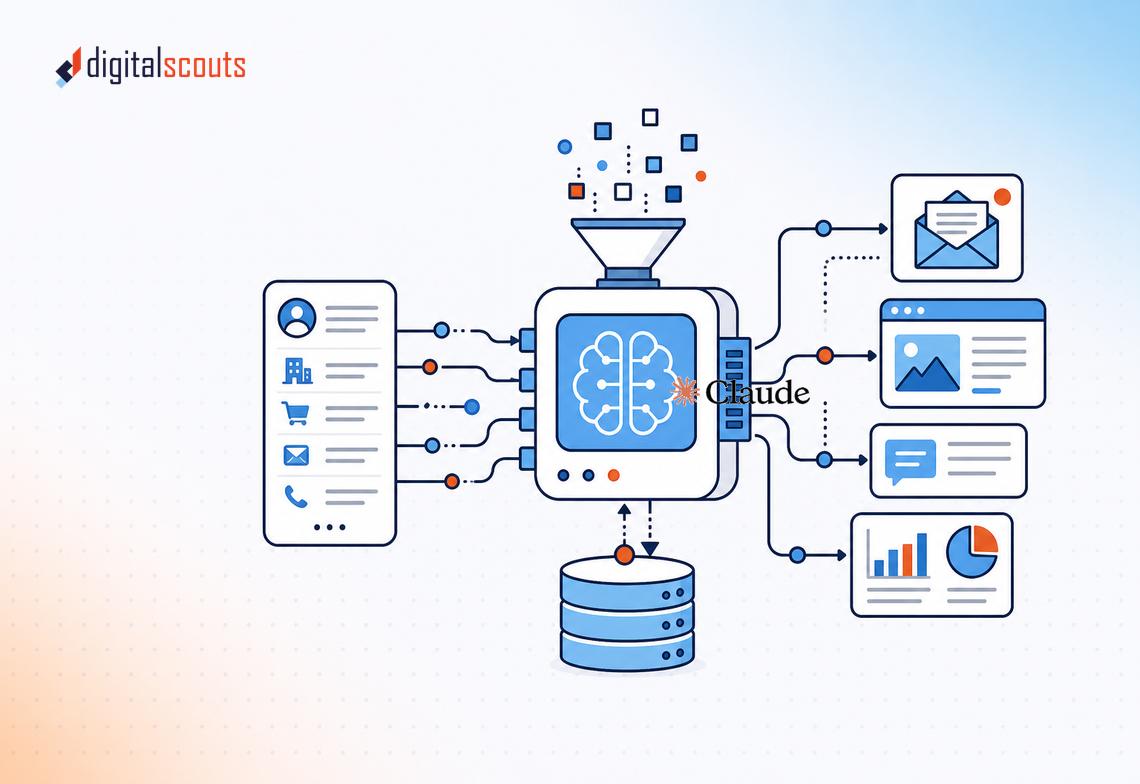
Claude does not replace your marketing tools. It works alongside them. Think of Claude as a strategic layer — an assistant that helps you plan, create, analyse, and optimise, while your existing platforms handle execution and distribution.
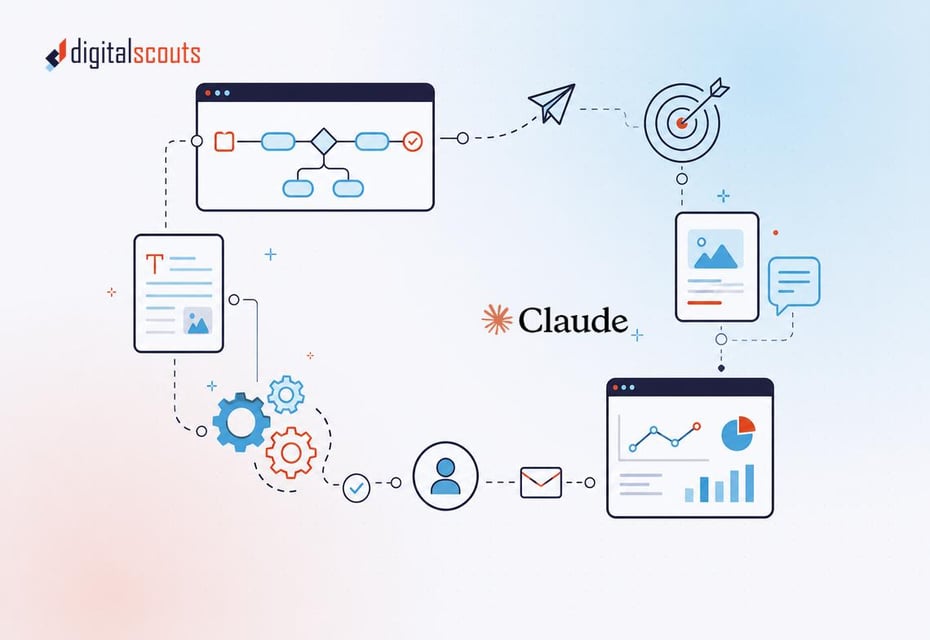
Here is how Claude fits into a typical B2B marketing workflow:
- Strategy and planning: Claude helps research audiences, map buyer journeys, and develop campaign frameworks
- Content creation: Claude drafts blog posts, email sequences, landing page copy, and social content with brand-aligned tone
- Analysis and optimisation: Claude reviews campaign data, identifies patterns, and suggests improvements
- Workflow automation: When integrated through APIs and tools like n8n, Claude powers automated marketing workflows that save hours each week
The following use cases show how B2B teams are putting Claude to work.
Use Case 1: Content Creation at Depth and Scale
Content remains the backbone of B2B marketing. But producing high-quality, technically accurate content at scale requires significant resources. Claude changes the economics of content production.
How teams use Claude for content
Claude excels at long-form, research-backed writing. B2B teams use it to:
- Draft blog posts and articles with industry-specific depth
- Write email sequences tailored to different buyer stages
- Create landing page copy optimised for conversion and SEO
- Produce case study summaries from raw interview notes
- Generate social media content across LinkedIn and other channels
Practical application
A B2B SaaS marketing team feeds Claude their product documentation, buyer personas, and competitor positioning. Claude drafts a four-part blog series on industry challenges, complete with relevant examples, data references, and natural CTAs. The team reviews, refines, and publishes — producing in days what previously took weeks.
The output is not generic AI content. Because Claude understands the product context and audience, the drafts read like they were written by someone who knows the space.
Use Case 2: Campaign Strategy and Audience Research
Before launching a campaign, marketing teams spend hours researching industries, identifying pain points, and mapping buyer journeys. Claude accelerates this significantly.
How teams use Claude for strategy
- Analyse industry reports and extract actionable insights
- Map buyer journeys across different segments
- Develop messaging frameworks aligned to buyer challenges
- Generate campaign briefs that connect strategy to execution
Practical application
A RevOps consultancy targeting mid-market manufacturers uploads industry data and customer win/loss notes into Claude. Claude identifies three recurring pain points, maps them to specific buyer roles, and suggests messaging angles for each. The team builds an ABM campaign around these insights, cutting research time from two weeks to two days.
Use Case 3: Data Analysis and Campaign Optimisation
Most B2B marketing teams collect more data than they can meaningfully analyse. Claude turns raw data into actionable intelligence.
How teams use Claude for analysis
- Review campaign performance data and surface patterns
- Analyse email engagement metrics to identify high-performing content
- Segment audiences based on behavioural signals
- Generate A/B test hypotheses from historical data
Practical application
A marketing team exports their last quarter of HubSpot campaign data and uploads it to Claude. Within minutes, Claude identifies that emails sent on Tuesday mornings outperform Thursday afternoons by 34%. It also spots that accounts in the technology sector engage most with case study content rather than educational articles. The team adjusts their email cadence and content mix accordingly — lift in open rates follows within two weeks.
Use Case 4: Personalised ABM Outreach
Account-based marketing requires personalisation at an account level. This has traditionally been resource-intensive. Claude makes it scalable.
How teams use Claude for ABM
- Research target accounts and extract relevant context
- Draft personalised outreach sequences for each account
- Create account-specific landing pages and content
- Generate meeting briefs that prepare sales for conversations
Practical application
A B2B company targeting 30 high-value accounts uses Claude to generate personalised outreach for each. For every account, Claude reviews publicly available information — recent news, leadership changes, technology stack — and crafts email sequences that reference specific challenges and opportunities. The sales team reviews and sends. Reply rates are significantly higher than generic outreach because the messaging demonstrates genuine understanding of each account's context.
Use Case 5: Building AI-Powered Marketing Workflows
Claude becomes even more powerful when integrated into automated workflows. Through APIs and platforms like n8n or HubSpot, Claude can power end-to-end marketing processes without manual prompting.
How teams build Claude-powered workflows
- Automate content creation triggered by CRM events (new deal, stage change)
- Generate personalised follow-up emails when prospects engage with content
- Create weekly campaign performance summaries delivered to Slack or email
- Build lead scoring models using AI-driven pattern recognition
Practical application
A B2B company connects Claude to HubSpot via n8n. When a new deal enters the pipeline, Claude automatically generates a personalised onboarding email sequence based on the account's industry, size, and deal stage. When a prospect downloads a specific piece of content, Claude creates a tailored follow-up email referencing the content and suggesting next steps. The marketing team sets the rules; Claude executes.
Use Case 6: Sales Enablement and Competitive Intelligence
Sales teams need the right information at the right time. Claude helps marketing teams equip sales with the intelligence they need to win deals.
How teams use Claude for sales enablement
- Generate competitive battle cards from public information
- Create account-specific briefing documents before calls
- Draft proposal content matched to prospect pain points
- Summarise call transcripts and extract action items
Practical application
Before a major enterprise pitch, the marketing team uploads the prospect's annual report, recent press coverage, and known technology stack into Claude. Claude produces a three-page briefing that includes the prospect's strategic priorities, likely pain points, and suggested positioning angles. The sales team walks into the meeting informed and prepared — not starting from a generic discovery script.
Building Your Claude-Powered Marketing Workflow
Integrating Claude into your marketing operations does not require a complete overhaul. Start with the use cases that address your biggest bottleneck.
Start with content, then expand
Content creation is the most accessible entry point. Most teams see immediate value before expanding into analytics and automation.
Use Projects for team collaboration
Claude's Projects feature lets you organise conversations around specific campaigns, clients, or content streams. Upload brand guidelines, product documentation, and audience research once — Claude references them across every interaction.
Connect Claude to your existing stack
Claude works alongside your CRM, marketing automation platform, and analytics tools. API integrations through n8n or custom development turn Claude from a helpful assistant into an always-on marketing engine.
Focus on data quality
Claude's output is only as good as the data and context you provide. Invest in clean CRM data, clear brand guidelines, and documented processes before scaling AI across your marketing team.
Common Mistakes to Avoid
Treating Claude like a search engine
Claude is not Google. It is a reasoning and creation tool. The best results come from providing context and treating interactions as collaborative conversations, not one-line queries.
Publishing AI content without human review
Claude produces excellent drafts, but every piece of B2B content should pass through human review. Accuracy, brand voice, and strategic positioning require human judgement — Claude accelerates the process but does not replace it.
Ignoring data privacy considerations
While Claude is built with safety in mind, marketing teams handling sensitive customer data should establish clear guidelines about what information is shared with AI tools. Review Anthropic's data usage policies and align with your organisation's compliance requirements.
Adopting too many use cases at once
Start with one or two workflows. Measure results. Expand from there. Teams that try to integrate AI across every function simultaneously often struggle with adoption and consistency.
Bringing It All Together
Claude is not a marketing automation platform. It is a strategic capability that makes your existing marketing operations faster, smarter, and more effective.
Whether you are drafting content, analysing campaigns, personalising ABM outreach, or building automated workflows, Claude helps you focus on the work that drives revenue — not the manual tasks that consume your week.
The B2B teams winning with AI are not the ones with the most tools. They are the ones that integrate AI thoughtfully into a clear marketing process. Claude is built for exactly that.
For practical workflows connecting Claude to your HubSpot instance, see our step-by-step Claude and HubSpot integration guide. DigitalScouts helps B2B organisations operationalise Claude across their marketing and RevOps workflows. As an Anthropic partner, we bring deep expertise in Claude, HubSpot, and marketing automation — ensuring your team gets real results, not just AI hype.
About Author

Matthew Rowlands is an AI & Digital Strategist at DigitalScouts, where he helps B2B teams integrate AI tools like HubSpot Breeze Agents into their marketing and RevOps workflows. He writes about automation, SEO, and using generative AI to scale content and campaigns.