Go-to-market strategy has changed. Traditional playbooks built on broad targeting, manual outreach, and static content no longer deliver consistent results. What matters now is how precisely you can identify the right accounts, engage them with relevance, and convert them efficiently.
AI has moved from experimental to essential in B2B GTM. Teams that integrate AI into their go-to-market workflows are seeing faster pipeline, higher conversion rates, and better alignment between marketing and sales.
This is not about replacing strategy with automation. It is about using AI to sharpen targeting, scale personalisation, and make smarter decisions across the entire GTM funnel.
This guide covers six practical use cases where AI is making a measurable impact on B2B go-to-market execution.
Why AI Matters for B2B Go-to-Market
Most B2B GTM teams face the same structural challenges. Too many accounts to qualify manually. Generic outreach that fails to convert. Content that does not match buyer intent. And limited visibility into what is actually working.
AI addresses these challenges in three ways:
1. Precision at scale
AI processes signals across thousands of accounts to identify the ones most likely to convert, enabling teams to focus resources where they matter most.
2. Relevance without manual effort
AI enables personalised messaging, content recommendations, and outreach sequences that adapt to each account's context without requiring armies of SDRs.
3. Continuous intelligence
AI analyses engagement patterns, win rates, and pipeline velocity to surface insights that improve GTM performance over time.
When integrated into CRM and marketing automation platforms, these capabilities create a GTM engine that learns and improves with every interaction.
Understanding AI's Role Across the GTM Funnel
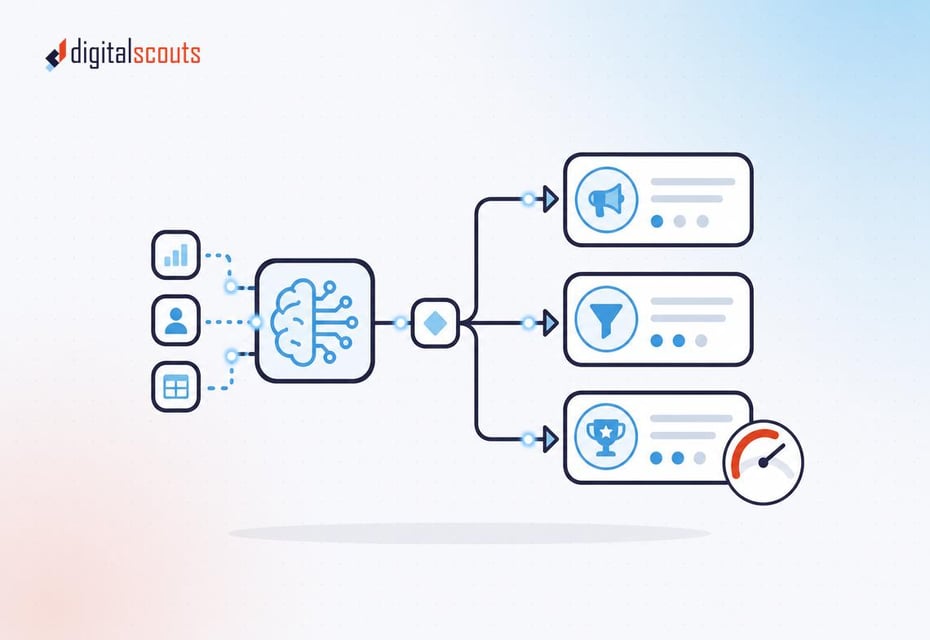
AI does not replace any single function in GTM. It augments every stage:
- Market intelligence: AI analyses intent data, technographics, and firmographics to identify high-fit accounts
- Account engagement: AI personalises outreach and content across channels
- Pipeline management: AI scores leads, predicts conversion likelihood, and flags at-risk deals
- Revenue intelligence: AI connects GTM activities to revenue outcomes and forecasts
The following use cases show how this works in practice.
Use Case 1: AI-Powered Account Identification and Prioritisation
The traditional approach to account selection relies on static ICP definitions and manual research. This misses accounts that are actively in market and wastes effort on accounts that are not.
How AI improves account selection
AI tools analyse multiple signals simultaneously:
- Intent data showing which accounts are researching relevant topics
- Technographic data revealing technology stacks and gaps
- Firmographic filters for company size, industry, and growth stage
- Historical win data identifying patterns in closed-won deals
Practical application
Instead of working through a static list of 2,000 accounts, your team focuses on the 200 showing active buying signals. AI refreshes this list continuously as new signals emerge.
Platforms like HubSpot, 6sense, and Apollo now include AI-driven scoring that surfaces accounts based on fit, intent, and engagement — not just form fills.
The result is higher conversion rates because you are engaging accounts that are already in market.
Use Case 2: Personalised Outreach at Scale
Generic outreach is the fastest way to burn your addressable market. But personalisation at scale has historically required large SDR teams.
How AI enables personalised outreach
AI analyses account context — recent news, job changes, funding events, technology usage — and generates relevant messaging for each account. This goes beyond merge fields to create genuine relevance.
Practical application
A B2B SaaS company targeting mid-market manufacturers uses AI to:
- Scan for accounts that recently hired a new VP of Operations
- Identify technology gaps in their current stack
- Generate email sequences referencing specific operational challenges
- Adjust messaging tone based on industry and role
The outreach is not templated. Each sequence is built around the account's actual context, increasing reply rates and meeting bookings.
Tools like Clay, Outreach, and HubSpot Breeze Agents make this workflow accessible without custom development.
Use Case 3: AI-Driven Content for Each Stage of the Buyer Journey
Content remains the backbone of B2B GTM. But static content libraries fail to address the specific needs of different accounts at different stages.
How AI transforms content in GTM
AI enables dynamic content that adapts to:
- Account stage: Awareness content for new accounts, comparison content for evaluating accounts, case studies for decision-ready accounts
- Industry context: Industry-specific examples and use cases
- Role: Technical depth for practitioners, business outcomes for executives
Practical application
A RevOps consultancy (like DigitalScouts) uses AI to:
- Generate industry-specific blog posts targeting commercial intent keywords
- Create personalised landing pages for ABM campaigns
- Produce case study summaries matched to prospect industry and size
- Build email content that aligns with each account's current stage in the funnel
The content engine produces relevant assets without requiring a large content team. AI handles drafting and structure; human oversight ensures strategic positioning and brand alignment.
HubSpot CMS with AI-powered workflows makes this scalable. Content is created, optimised, and distributed through automated sequences connected to CRM data.
Use Case 4: Intelligent Lead Scoring and Routing
Traditional lead scoring relies on explicit actions: form fills, page visits, email clicks. This misses the broader context of buyer intent and often routes leads incorrectly.
How AI improves scoring and routing
AI scoring models analyse:
- Behavioural patterns across sessions and channels
- Account-level engagement (multiple contacts from the same company)
- Intent signals from third-party sources
- Historical conversion patterns from similar accounts
Practical application
A B2B company sets up AI-driven scoring in HubSpot that:
- Automatically adjusts scores based on engagement velocity
- Flags accounts where multiple contacts are researching simultaneously
- Routes high-intent leads to sales within minutes, not hours
- Suppresses low-quality leads that match patterns of non-converting accounts
The sales team stops chasing every form fill and focuses on accounts with genuine buying intent. Conversion rates improve because timing and context are better aligned.
Use Case 5: Sales Enablement with Real-Time Intelligence
Sales teams often walk into conversations with incomplete information. They know the account name and industry but miss the context that makes conversations productive.
How AI enables sales teams
AI provides real-time intelligence during the sales process:
- Account research summaries before meetings
- Relevant content recommendations based on deal stage
- Competitive intelligence surfaced during deal review
- Next-best-action suggestions based on engagement patterns
Practical application
Before a discovery call, AI generates a briefing that includes:
- The account's technology stack and potential gaps
- Recent news, funding, or leadership changes
- Content the account has already consumed
- Suggested questions based on their industry and stage
The conversation starts from a position of knowledge, not a generic discovery script. This builds credibility and shortens sales cycles.
HubSpot's Breeze Agents and tools like Gong and Clari now embed AI-driven insights directly into the rep's workflow.
Use Case 6: Pipeline Forecasting and Revenue Intelligence
Most B2B companies rely on manual pipeline reviews and subjective deal assessments. This leads to inaccurate forecasts and reactive decision making.
How AI improves forecasting
AI analyses objective signals to predict outcomes:
- Deal velocity compared to historical averages
- Engagement patterns across the buying group
- Competitor presence in the deal
- Changes in stakeholder involvement
Practical application
AI-driven forecasting surfaces:
- Deals likely to close this quarter with high confidence
- Deals at risk that require intervention
- Pipeline gaps that need filling to hit targets
- Historical patterns that inform resource allocation
Leadership moves from reactive pipeline reviews to proactive decision making. Teams know which deals need attention and where to invest additional resources.
Building Your AI-Enabled GTM Stack
Adopting AI in GTM does not require replacing your entire tech stack. Most organisations can start with the platforms they already use.
Start with your CRM as the foundation
HubSpot, Salesforce, and similar platforms now include native AI capabilities for scoring, content generation, and forecasting. Enable these features before adding point solutions.
Layer in AI tools for specific use cases
Add specialised tools where native capabilities fall short:
- Intent data: 6sense, Bombora
- Outreach personalisation: Clay, Apollo
- Conversation intelligence: Gong, Chorus
- Forecasting: Clari, BoostUp
Focus on data quality first
AI is only as good as the data it analyses. Clean CRM data, proper attribution, and consistent tracking are prerequisites for meaningful AI outputs.
Common Mistakes to Avoid
Many teams adopt AI tools without a clear GTM strategy.
Automating broken processes
AI cannot fix a GTM process that is fundamentally misaligned. Define your ICP, buyer journey, and handoff process before layering in AI.
Over-relying on AI-generated outreach
AI can draft relevant messaging, but human oversight is essential for authenticity. Generic AI content erodes trust quickly.
Neglecting data hygiene
AI-driven scoring and routing fail when CRM data is incomplete or outdated. Invest in data quality before deploying AI at scale.
Adding tools without integration
Standalone AI tools that do not connect to your CRM create silos and inconsistent experiences. Prioritise integration over feature count.
Bringing It All Together
AI is not a replacement for GTM strategy. It is a force multiplier that enables teams to execute with greater precision, speed, and consistency.
The most effective B2B organisations are not the ones with the most AI tools. They are the ones that integrate AI into a clear GTM process: identifying the right accounts, engaging them with relevance, and converting them efficiently.
Start with the use cases that address your biggest GTM bottleneck. Measure the impact. Expand from there.
For teams choosing an AI platform to power their GTM workflows, our data-driven comparison of Claude, ChatGPT, and Gemini evaluates each platform against real B2B use cases. DigitalScouts helps B2B organisations build AI-enabled GTM systems within HubSpot. From account selection and personalised outreach to pipeline intelligence, we ensure your go-to-market engine drives predictable revenue.
Frequently Asked Questions
About Author

Ashish is a B2B growth strategist who helps scaleups align marketing and sales through Account-Based Marketing (ABM), RevOps, and automation. At DigitalScouts, he builds scalable content engines, streamlines lead flows with HubSpot, and runs targeted GTM programs to drive predictable pipeline. He regularly shares insights on using AI and automation to power ABM and accelerate complex buyer journeys.